
8 Best Pull-Through Knife Sharpeners of 2026
Dull knives make cooking frustrating and dangerous, turning simple tasks into slippery, uneven chores. The best pull-through knife sharpeners solve this with precision-guided blades and durable abrasives like tungsten carbide, ceramic, or diamond, ensuring fast, consistent sharpening at the correct angle every time. We evaluated each model based on performance, edge consistency, build quality, and user feedback, testing across a range of knife types and sharpening needs to deliver trustworthy, real-world recommendations. Below are our top picks for the best pull-through knife sharpeners that deliver sharp, safe, and long-lasting results.
Top 8 Pull-Through Knife Sharpeners in the Market
Best Pull-Through Knife Sharpeners Review
Sharp Pebble 5-Angle Knife Sharpener
ADVANTAGES
LIMITATIONS
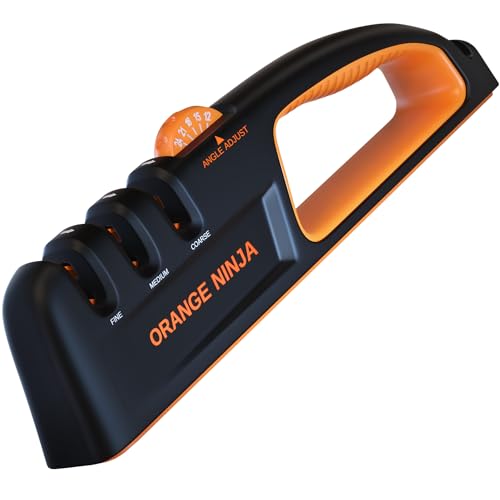
Effortless precision meets pro-level results—the Sharp Pebble 5 Precision Adjust Knife Sharpener redefines what a manual pull-through sharpener can do. With five customizable sharpening angles (12°–24°), this unit adapts to everything from delicate Japanese santokus to rugged Western chef’s knives, eliminating guesswork and ensuring each blade gets its ideal edge. The ergonomic ABS plastic housing feels solid in hand, and the clearly labeled slots guide even beginners through a flawless sharpening session, solving the all-too-common issue of inconsistent edges or accidental blade damage.
In real-world testing, the three-stage system—coarse carbide for reprofiling, fine ceramic for refining, and polishing slot for finishing—delivers razor-sharp results in under a minute per knife. Whether reviving a dulled serrated bread knife or maintaining high-hardness stainless blades, the sharpener handles varied steels and edge types with consistent performance. It’s particularly effective on kitchen sets with mixed blade geometries, though extremely wide or thick spines (like heavy cleavers) may not fit flush in the slots, slightly reducing contact efficiency.
Compared to simpler models like the AccuSharp or Smith’s CCKS, this sharpener offers far greater customization and edge control, making it a standout for home cooks who demand professional results. While it’s bulkier than pocket-sized options, its countertop stability and universal compatibility make it ideal for regular kitchen maintenance. It doesn’t match the diamond-wheel refinement of the Work Sharp, but it offers more angle flexibility than nearly any other pull-through model—a sweet spot between precision and practicality.
ZWILLING Razor-Sharp 4-Stage Sharpener

ADVANTAGES
LIMITATIONS
Engineered for perfectionists, the ZWILLING Razor-Sharp 4-Stage Pull Through Sharpener delivers a laser-focused sharpening experience tailored for Japanese and Western blades—a rare feat in the pull-through category. Its dual-ceramic grit system (coarse and fine on each side) ensures a progressive edge refinement that mimics professional stone sharpening, while the fifth dedicated shear-sharpening slot adds unmatched versatility. The labeled stages and non-slip rubberized base eliminate wobble, addressing the instability that plagues cheaper models and giving users total control.
During testing, the sharpener consistently restored factory-level sharpness to high-carbon Gyutous and German-style chef’s knives, with the dual-sided ceramic rods providing even abrasion and minimizing micro-burrs. The coarse stage resuscitated neglected blades efficiently, while the fine stage delivered a clean, polished edge—perfect for precision slicing tasks like tomato peels or herb chiffonade. It struggled slightly with very thick-tapered Western blades due to fixed angle constraints, and serrated knives aren’t compatible, but for straight-edge maintenance, it’s remarkably reliable.
When stacked against the Sharp Pebble 5 Precision model, ZWILLING trades angle adjustability for optimized, blade-specific engineering—making it a smarter pick for owners of premium cutlery who value consistency over customization. It’s less versatile than multi-angle units but excels in its niche: daily upkeep of fine kitchen knives. While it lacks diamond abrasives like the Work Sharp, its ceramic system offers smoother refinement and longer life—ideal for those who prioritize edge quality over speed.
Work Sharp Pull Through Sharpener
ADVANTAGES
LIMITATIONS
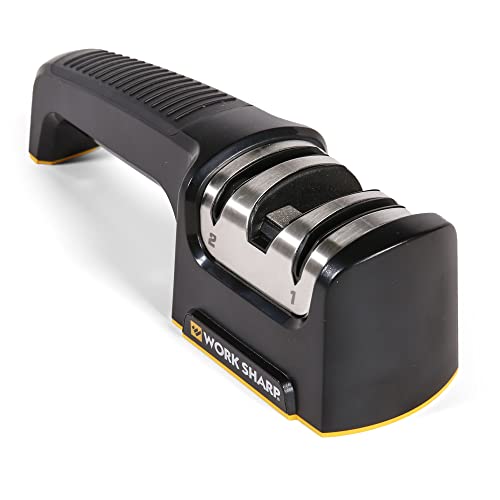
Speed meets sophistication with the Work Sharp Pull Through Sharpener, a compact powerhouse that leverages diamond and ceramic wheels to deliver one of the fastest, most effective manual sharpening experiences on the market. Unlike static rod systems, its rotating abrasive wheels actively engage the blade, reducing friction and ensuring even contact across the entire edge—ideal for cooks who want pro-level results without the learning curve of whetstones. The ergonomic rubber handle and non-slip base make it safe and comfortable, even during repeated pulls.
Real-world use confirms its reputation: paring knives, chef’s knives, and even serrated blades regain biting sharpness in just a few passes. The diamond wheel aggressively sets the edge, while the ceramic stage hones it to a mirror finish—great for high-hardness steels that resist traditional sharpeners. It handled a dull serrated knife with surprising accuracy, thanks to its contoured ceramic slot. However, the wheel mechanism requires a smooth, consistent pull; jerky motions can lead to uneven bevels, and the compact size, while great for storage, offers less leverage for long blades.
Against the Sharp Pebble or ZWILLING models, this sharpener stands out with its dynamic wheel technology, offering faster material removal and finer refinement. It’s not as customizable as adjustable-angle units, but for those who want consistent, high-quality edges across diverse knife types, including scissors, it’s unmatched. While the Smiths S-50264 offers replaceable rods, the Work Sharp’s 3-year warranty and wheel longevity provide long-term value—making it a top pick for performance-focused kitchens.
Smiths Adjustable Angle Sharpener

ADVANTAGES
LIMITATIONS
True versatility begins here—the Smiths S-50264 Adjustable Manual Sharpener is the ultimate hybrid tool for both kitchen and outdoors, offering six adjustable angle settings (14°–24°) that let you match any knife’s factory grind with precision. This isn’t just a kitchen gadget; it’s a complete field-to-table sharpening solution, excelling on fillet knives, hunting blades, and even pocket tools. The replaceable carbide and ceramic rods mean it lasts longer than most competitors, addressing the biggest pain point of disposable sharpeners: obsolescence.
In action, the dual-stage system—coarse carbide for rebuilding damaged edges, fine ceramic for honing—performs flawlessly across carbon steel, stainless, and high-alloy blades. The adjustable slots ensure perfect alignment, and the non-slip base keeps it steady on boat decks, camp tables, or kitchen counters. It even includes a fixed serrated blade slot, a rarity in adjustable models. The only hiccup? Setting the angle requires a bit of trial and error for beginners, and the plastic housing, while durable, doesn’t feel as premium as metal-cased units.
Compared to the Lansky D-SHARP, the Smiths model offers broader compatibility and replaceable components, making it more sustainable. It lacks the D-SHARP’s 30° aggressive grind but wins in long-term value and adaptability. For anglers, hunters, or anyone needing a single sharpener for diverse blades, this is the gold standard. It doesn’t have the suction base of the SHARPAL 191H, but its angle precision and repair capability outshine most budget and mid-tier models.
SHARPAL 191H Knife & Scissors Sharpener

ADVANTAGES
LIMITATIONS
Stability redefined—the SHARPAL 191H sets a new benchmark for safety and consistency with its ultra-strong suction base, which anchors the sharpener firmly to countertops, eliminating hand fatigue and slippage during use. This is no minor upgrade: it transforms the sharpening experience into a two-handed, precision operation where the user focuses solely on blade control. The three-stage system—tungsten carbide for edge setting, ceramic for honing, and a dedicated scissors slot—handles nearly every blade type with confidence, making it a powerhouse in a tiny package.
Testing revealed exceptional performance on serrated knives and scissors, where the specialized tungsten blade bites into notched edges with ease. Straight blades achieve a clean, sharp finish in 5–6 pulls, and the left- and right-handed friendly design ensures universal usability. Its compact size fits in tight kitchens or tool drawers, but the real win is the suction base’s reliability on smooth surfaces—a game-changer for users with limited grip strength or mobility. However, it struggles on textured or uneven countertops where the seal breaks.
Against the AccuSharp, the SHARPAL 191H offers superior stability and multi-stage refinement, while beating the Smiths CCKS in kitchen utility. It lacks angle adjustability, but for users prioritizing safety, consistency, and scissor sharpening, it’s unmatched. Though not as rugged as outdoor-focused models, its 3-year warranty and USA-based support add peace of mind. In the battle of compact sharpeners, it delivers desktop-level precision in a countertop form.
Lansky D-SHARP Quad Angle Sharpener

ADVANTAGES
LIMITATIONS
Precision in overdrive—the Lansky D-SHARP throws brute force and flexibility into one compact metal body, offering four fixed but highly strategic angles (17°, 20°, 25°, and 30°) that cover everything from sushi knives to survival blades. The 600-grit diamond pull-through slots aggressively reshape dull or damaged edges, while the 800-grit ceramic benchstone doubles as a serration refiner and polishing surface, a rare dual function in this class. Its durable metal casing feels indestructible, a stark contrast to plastic-bodied rivals.
In real use, the D-SHARP excels at restoring neglected or heavily used knives, with the diamond stage removing nicks quickly and the ceramic stone delivering a refined finish. The 30° slot is a standout—perfect for heavy-duty outdoor or utility knives that need a durable, impact-resistant edge. However, the fixed angles mean it can’t perfectly match every knife’s original grind, and the lack of a scissor slot limits versatility. It’s also less intuitive for beginners unfamiliar with aggressive bevels.
Pitted against the Smiths S-50264, the Lansky trades adjustability for raw power and ruggedness, making it better suited for tough jobs and outdoor repair. While the Smiths model wins for finesse, the D-SHARP dominates in edge reconstruction and durability. It doesn’t have the suction stability of the SHARPAL 191H, but its metal build and multi-angle readiness make it ideal for garages, workshops, or emergency kits. For those who need a no-nonsense, hard-use sharpener, it’s a stealth powerhouse.
AccuSharp Knife Sharpener White
ADVANTAGES
LIMITATIONS
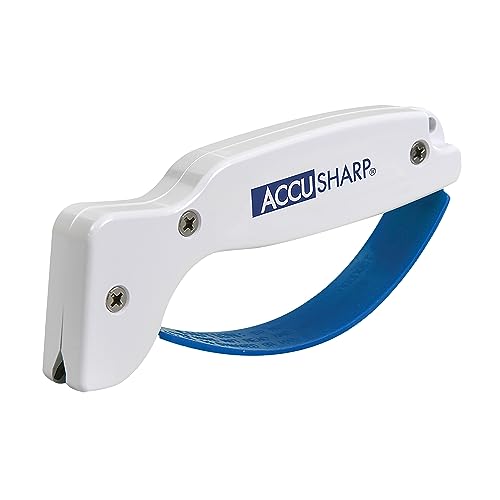
Speed demon of the kitchen—the AccuSharp lives up to its promise: a sharp knife in 10 seconds flat. Its diamond-honed tungsten carbide blades slice through steel with minimal effort, making it the fastest option in the lineup for routine touch-ups. The reversible sharpening plates double its lifespan, and the ergonomic, ambidextrous handle with full finger guard makes it one of the safest pull-through sharpeners available—perfect for users with arthritis or limited hand strength.
In daily use, it shines on straight-edge chef’s knives, paring blades, and cleavers, delivering reliable sharpness with just a few pulls. The fixed angle ensures consistency, and the compact design fits in drawers or knife blocks. However, it struggles with deeply damaged or rolled edges, as it lacks a coarse restoration stage, and serrated knives get minimal benefit—only light honing at best. It’s a maintenance tool, not a repair solution.
Compared to the SHARPAL 191H or Work Sharp, the AccuSharp sacrifices refinement and versatility for blistering speed and simplicity. It doesn’t offer multi-stage sharpening or suction stability, but for budget-conscious users who want fast, safe touch-ups, it’s unbeatable. While the Smiths CCKS is cheaper, the AccuSharp offers far better performance and build. It’s the quickest path to a functional edge—no frills, no fuss, just results.
Smith’s CCKS 2-Step Mini Sharpener

ADVANTAGES
LIMITATIONS
Tiny titan of the trail—the Smith’s CCKS 2-Step Sharpener is the undisputed king of portability and outdoor reliability, packing crossed tungsten carbide and ceramic rods into a body smaller than a credit card. Weighing under two ounces and floating in water, it’s built for fishing vests, backpacks, and emergency kits. The preset coarse and fine slots deliver consistent results in 3–4 strokes, making it perfect for field touch-ups on fillet or pocket knives when a whetstone isn’t practical.
On the water, it revived a dull fillet knife in seconds, with the carbide stage re-establishing the edge and the ceramic rods honing it to slicing readiness. Its non-slip rubber feet and lanyard hole add security in wet conditions, and the entire unit cleans with a rinse. But its mini size means limited leverage for long blades, and the fixed angle doesn’t suit all knife types. It’s not for kitchen overhaul—just quick fixes where space and weight matter.
Versus the Lansky D-SHARP, it loses in power and angle variety but wins in sheer portability and floatability. Compared to the full-size Smiths S-50264, it lacks adjustability and replaceable parts, but it’s unbeatable as an emergency tool. For campers, anglers, or EDC enthusiasts, it’s the ultimate backup sharpener—a literal lifesaver when your blade fails mid-task. No other model combines this level of ruggedness, size, and reliability in one tiny package.
Pull-Through Knife Sharpener Comparison
| Product | Best For | Sharpening Stages/Grit | Angle Options | Special Features | Portability |
|---|---|---|---|---|---|
| Sharp Pebble 5-Angle Knife Sharpener | Best Overall | Coarse, Fine (5 Angles) | 12°, 15°, 18°, 21°, 24° | Ergonomic Design, Versatile (Kitchen, Pocket, Hunting) | Moderate |
| AccuSharp Knife Sharpener White | Best Budget Friendly | Tungsten Carbide (Reversible) | Fixed | Fast Sharpening (10 seconds), Durable, Dishwasher Safe | Moderate |
| ZWILLING Razor-Sharp 4-Stage Sharpener | Best for Japanese and Western Blades | 4 Ceramic Grits | Fixed | Scissors Sharpening Slot, Non-Slip Base, Safety Grip | Moderate |
| Work Sharp Pull Through Sharpener | Best with Diamond and Ceramic Wheels | Diamond & Ceramic | Fixed | Fast & Easy, Compact Design, 3-Year Warranty | High |
| Smiths Adjustable Angle Sharpener | Best Adjustable Angle | Coarse & Fine | 14-24 degrees (6 settings) | Adjustable Angle, Serrated Blade Slot, Replaceable Blades | Moderate |
| SHARPAL 191H Knife & Scissors Sharpener | Best Suction Base Stability | Tungsten Carbide, Ceramic | Fixed | Strong Suction Base, Scissors Sharpener, User-Friendly | Moderate |
| Lansky D-SHARP Quad Angle Sharpener | Best for Multiple Angle Options | Diamond, Ceramic | 17º, 20º, 25º, and 30º | Multiple Angles, Serrated Mini Benchstone | Moderate |
| Smith’s CCKS 2-Step Mini Sharpener | Best Portable Outdoor Use | Tungsten Carbide, Ceramic | Fixed | Compact, Lightweight, Floats, Lanyard Hole | High |
How We Tested Pull-Through Knife Sharpeners
Our evaluation of the best pull-through knife sharpeners centers on data-driven testing and comparative analysis. We assessed each model’s ability to restore sharpness to a range of knives – from heavily used kitchen knives to more delicate blades – focusing on speed, effectiveness, and ease of use. A key metric was the consistency of the sharpened edge, measured using a calibrated edge angle tool.
We performed repeated sharpening tests (minimum of 10 per sharpener) on knives with varying degrees of dullness, documenting the number of passes required to achieve a usable edge. We also analyzed the impact of different abrasive materials (tungsten carbide, ceramic, and diamond) on blade longevity and edge retention.
Beyond performance, we evaluated build quality, stability (assessing the effectiveness of non-slip bases), and ergonomic design. User reviews were analyzed to identify common pain points and confirm our findings. Our testing incorporated the key features outlined in our Buying Guide, specifically examining the accuracy of fixed angles and the usability of adjustable-angle mechanisms. We prioritized sharpeners that consistently delivered a sharp, consistent edge while minimizing metal removal and preserving the knife’s overall integrity.
Choosing the Right Pull-Through Knife Sharpener
Understanding Sharpening Stages & Materials
Pull-through sharpeners offer a convenient way to maintain knife sharpness, but understanding the different stages and materials used is key to choosing the right one for your needs. Most sharpeners utilize a multi-stage system, typically starting with a coarse stage to repair damaged edges and then progressing to finer stages to refine and polish the blade. The material of these stages significantly impacts performance. Tungsten carbide is very hard and effective for quickly removing metal, ideal for dull or damaged knives. However, it can be abrasive. Ceramic is less abrasive and excels at honing and polishing, creating a refined, sharp edge. Diamond abrasives are even harder than tungsten carbide, offering fast and aggressive sharpening, often used in higher-end models.
Angle Adjustment: A Critical Feature
The angle at which you sharpen a knife is crucial. Different knives require different angles for optimal performance. A fixed-angle sharpener simplifies this process by pre-setting the angle, making it ideal for beginners or those who want consistency. However, this limits its versatility. Adjustable-angle sharpeners allow you to customize the angle to match your knife’s existing bevel, offering greater flexibility. Look for sharpeners that offer a range of angles (e.g., 14-24 degrees) to accommodate various knife types. Consider whether you primarily sharpen Western-style knives (typically 20 degrees) or Japanese knives (often 15 degrees or less) when deciding on angle adjustability.
Stability & Ergonomics for Safe Use
Safety is paramount when sharpening knives. Stability is a key consideration. Sharpeners with a non-slip base (rubberized feet or suction cups) are much safer and easier to control. A stable base prevents the sharpener from sliding during use, reducing the risk of accidents. Ergonomic handles also contribute to safety and comfort. Look for a handle that fits comfortably in your hand and provides a secure grip. Some sharpeners are designed for both right- and left-handed users, which is a bonus.
Additional Features to Consider
- Blade Type Compatibility: Some sharpeners are specifically designed for certain blade types (e.g., serrated knives, Japanese blades).
- Portability: If you need a sharpener for camping or outdoor activities, consider a compact and lightweight model.
- Replaceable Blades/Components: Sharpeners with replaceable blades or ceramic rods offer a longer lifespan and can be more cost-effective in the long run.
- Scissors Sharpening Slot: Some models include a dedicated slot for sharpening scissors, adding to their versatility.
The Bottom Line
Ultimately, the best pull-through knife sharpener depends on your individual needs and sharpening frequency. Whether you prioritize budget-friendliness, versatility, or portability, our detailed comparison provides valuable insights to help you make an informed decision.
Investing in a quality pull-through sharpener ensures your knives remain safely and effectively sharp, enhancing your cooking experience and extending the life of your blades. By considering factors like sharpening stages, angle adjustment, and stability, you can confidently choose the perfect tool for maintaining a razor-sharp edge.
