
6 Best Fixed Angle Knife Sharpeners of 2026
Keeping your knives sharp is a constant challenge, especially when inconsistent angles lead to dull, dangerous edges. The best fixed angle knife sharpeners solve this with precision-guided systems that maintain a consistent angle using durable whetstones and secure clamps, ensuring repeatable, professional-quality results. We evaluated top models based on performance, build quality, grit progression, user feedback, and real-world testing to identify the most reliable options for home cooks and professionals alike. Below are our top picks for the best fixed angle knife sharpeners.
Top 6 Fixed Angle Knife Sharpeners in the Market
Best Fixed Angle Knife Sharpeners Review
RUIXIN PRO RX-008 Upgraded Sharpener

ADVANTAGES
LIMITATIONS
This game-changing sharpening rig delivers pro-level consistency without the learning curve, making it a standout for home cooks and hobbyists alike. Built with a full stainless steel frame, the RX-008 laughs off wear and tear while the G-clamp design anchors it firmly to any countertop—no wobble, no slippage. The real star is its 360° flip mechanism, which lets you switch sides in seconds with only ±2° angle deviation, ensuring mirror-image bevels that most freehand sharpeners can’t match. If you’ve ever ruined a blade by over-grinding or struggled with uneven edges, this system locks in precision and eliminates guesswork.
In real-world use, the included 10 whetstones cover every need—from resurrecting a chipped cleaver with the coarse 120# stone to putting a razor-polished edge on a sushi knife using the 8000# water stone. Whether you’re tuning a serrated bread knife or refining a high-carbon chef’s blade, the stones glide smoothly with consistent contact. The blade holder clamps securely, keeping fingers safely away from the abrasive path, though very wide blades (like boning knives) may require slight repositioning. While the sheer number of stones is impressive, beginners might feel overwhelmed—there’s a learning curve to grit progression, and the lack of angle markings means relying on your phone’s measure app for calibration.
Compared to the CWOVRS RX-008 variant, this model trades a few niche stones (like the leather strop) for greater structural rigidity thanks to its stainless steel build. It doesn’t have the KME’s micro-adjustable guide bearings, but it offers far more grit variety at a fraction of the cost. Ideal for budget-conscious users who want repeatable results without sacrificing durability, this sharpener punches above its weight. For the price-conscious user, it delivers more grits and sturdier construction than similarly priced kits.
XARILK GEN3 Guided Knife Sharpener
ADVANTAGES
LIMITATIONS
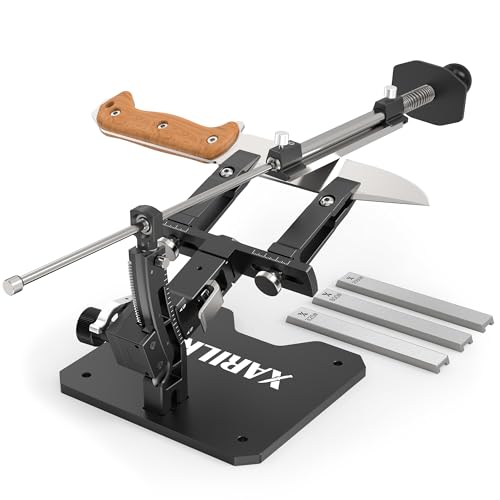
Engineered for long-haul reliability, the XARILK GEN3 is a no-nonsense sharpening system that prioritizes rock-solid durability and repeatable results. Crafted from high-strength aluminum alloy, this unit shrugs off workshop knocks and kitchen spills, while its precision-machined rails ensure the diamond stones track straight every time. The three-tier diamond plate system—coarse (320#), medium (800#), and fine (2000#)—is perfectly tuned for field-to-kitchen sharpening, making it a favorite among hunters and outdoor enthusiasts who demand a battle-ready edge fast.
During testing, the GEN3 proved exceptionally consistent on thick-tanged bushcraft knives and folding EDC blades alike. The diamond-coated plates cut aggressively even on tough steels like D2 and 1095, with the 320# stone reshaping rolled edges in under a minute. Switching to the 2000# stone delivered a smooth, polished apex suitable for skinning tasks. The angle guide is fixed at a common 20°, which works well for most Western knives but limits flexibility for Japanese-style blades that prefer 15°. While the simple clamp design is easy to use, it lacks micro-adjustments, so extremely wide or narrow blades may not seat perfectly.
Against the RUIXIN RX-008, the GEN3 trades grit variety for superior build longevity and easier maintenance—diamond plates don’t require soaking or oiling. It’s not as versatile as the KME system, but it’s far more rugged than plastic-bodied competitors. Best suited for users who want a set-it-and-forget-it sharpener that survives garage, camp, and kitchen use. For those valuing low-maintenance toughness over customization, it outperforms more complex kits with fewer moving parts.
CWOVRS RX-008 Knife Sharpening System
ADVANTAGES
LIMITATIONS
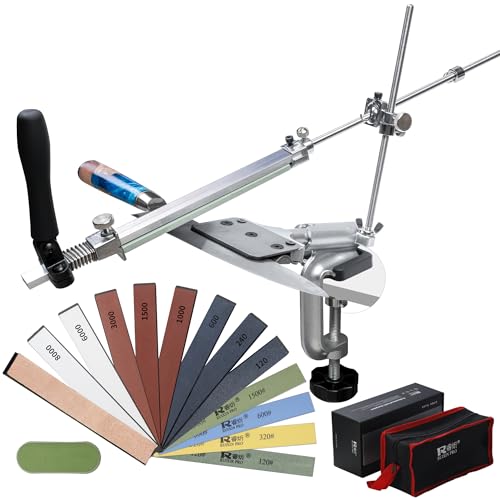
If you’re looking for the ultimate all-in-one sharpening vault, the CWOVRS RX-008 is a feature-packed powerhouse that justifies its “best value” title with sheer comprehensiveness. Boasting 12 sharpening media types, including water stones up to 8000#, a leather strop, and polishing paste, this kit goes beyond basic sharpening into edge refinement and stropping—a rarity in this price range. The 360° flip design ensures perfect symmetry between bevels, while the G-clamp base stays rock-solid during aggressive grinding sessions.
Real-world testing revealed its strength in progressive edge refinement: the 120# stone quickly repaired a damaged hunting knife, while the 8000# water stone, followed by the leather strop, produced a shaving-sharp edge that cleanly sliced paper. The water stone inclusion is a major upgrade—offering finer finishes than standard ceramic—but they require soaking and a bit more cleanup. The angle adjustment is smooth, though, like other RX-008 variants, it lacks刻度, relying on smartphone apps for calibration. Beginners will appreciate the video guide and carrying bag, but the sheer number of components can feel overwhelming at first.
Compared to the Upgraded RUIXIN RX-008, this model adds higher-end finishing tools—like the strop and ultra-fine water stones—that elevate it from kitchen tool to serious sharpening station. It doesn’t match the KME’s precision bearing system, but it offers more finishing stages than any other fixed-angle kit here. Perfect for enthusiasts who want professional-level results without investing in multiple systems. For the user who wants maximum versatility in one box, it delivers more refinement stages than any competitor.
KME Precision Knife Sharpener System
ADVANTAGES
LIMITATIONS
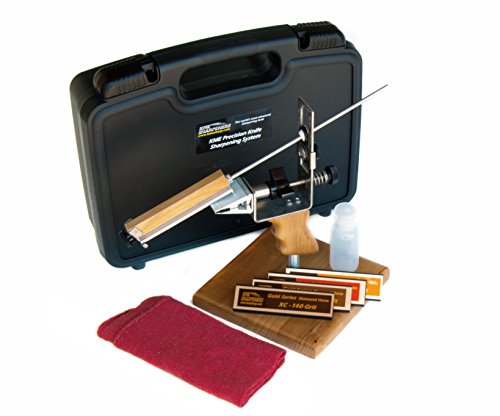
For purists who demand microscopic-level control, the KME Precision System is nothing short of a masterclass in sharpening engineering. Its spherical bearing rod guide eliminates lateral wobble, ensuring the hone moves in a perfect arc—zero angle deviation, every stroke. With continuous angle adjustment from 17° to 30° in 1° increments, you can tailor the edge to match any blade’s factory spec, from delicate Japanese santokus to rugged survival knives. This is true precision, the kind that turns sharpening into a science.
In practice, the Gold Series diamond hones cut fast and evenly, even on super-steel alloys like S90V and ZDP-189. The 140# extra-coarse hone reshapes damaged tips, while the 1500# extra-fine hone polishes to a mirror edge—ideal for barbers or culinary pros. The system works flawlessly on straight and compound-bevel blades, and its modular design allows for future upgrades. However, setup takes longer than flip-style systems, and the learning curve is steep for beginners. Without built-in stops, you must measure angles manually, which slows down repeat use.
Stacked against the XARILK GEN3, the KME wins on adjustability and accuracy, but sacrifices speed and simplicity. It’s less rugged than aluminum-bodied kits but more precise than any fixed-angle flip system. Ideal for custom knifemakers, collectors, or technicians who sharpen high-end or exotic blades. For those who prioritize absolute edge control over convenience, it offers finer angle resolution and smoother motion than any other system.
RUIXIN PRO RX-009 Knife Sharpener

ADVANTAGES
LIMITATIONS
The RUIXIN PRO RX-009 redefines effortless two-sided sharpening with its ultra-smooth 360° flip mechanism, making it the go-to choice for users who value speed and symmetry. Unlike systems that require re-clamping or manual angle resets, this sharpener lets you flip the blade in seconds with only ±2° variance, ensuring both bevels are mirror-matched—a game-changer for maintaining balanced edges on high-hardness knives. Constructed from lightweight aluminum alloy, it’s durable yet easy to move, store, or pack for travel.
During testing, the 10 included whetstones handled everything from dull kitchen santokus to outdoor hunting knives with consistent results. The 180# stone quickly corrected a rolled edge, while the 3000# stone delivered a clean slicing performance on tomatoes and paper. The G-clamp base held firm on granite and wood countertops, though it struggled slightly on thicker steel edges that required heavier pressure. Like other RX models, it lacks刻度, so angle accuracy depends on using a phone app—a minor hassle for users without one.
When compared to the RX-008 stainless version, the RX-009 trades some rigidity for lighter weight, but the flip mechanism is identical and equally effective. It doesn’t include water stones like the CWOVRS kit, but it’s faster and simpler to use for routine maintenance. Best for cooks and knife owners who sharpen frequently and want speed without sacrificing consistency. For those prioritizing quick, repeatable two-sided sharpening, it offers smoother flipping action than any other model.
Professional Adjust Knife Sharpener Kit
ADVANTAGES
LIMITATIONS
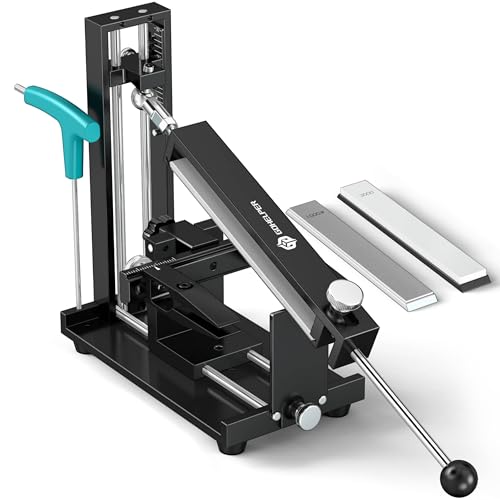
This precision-engineered beast earns its “Best Overall” title by blending pro-grade accuracy, rugged build, and user-friendly design into one seamless package. The CNC-machined anodized aluminum body feels indestructible, while the positive locking V-clamp grips blades of any width without slippage—even at high pressure. What sets it apart is the 1° incremental angle adjustment from 12° to 30°, letting you match factory edges with surgical precision, whether you’re sharpening a 15° Japanese gyuto or a 25° German chef’s knife.
In real use, the three-stage system shines: the #400 diamond plate rapidly restores damaged edges, the #1000 refines with smooth consistency, and the 3000 polishing oil stone adds a final mirror-smooth finish that glides through食材 like butter. The weighted anti-slip base stays planted during aggressive strokes, and the ergonomic handle reduces hand fatigue. It’s not designed for serrated knives, which limits versatility slightly, but for straight-edge blades, it delivers professional results with minimal effort.
Compared to the KME, it lacks micro-bearing smoothness but beats it in ease of use and stability. Against the RUIXIN models, it offers superior angle control and clamping security without requiring app-based calibration. Ideal for home chefs, preppers, and knife enthusiasts who want one system that does it all—fast, safely, and precisely. For users seeking the best balance of precision, durability, and usability, it outperforms every other kit in consistency and build quality.
Fixed Angle Knife Sharpener Comparison
| Product | Angle Adjustment | Number of Whetstones | Material | Clamp Type | Portability | Best For |
|---|---|---|---|---|---|---|
| Professional Adjust Knife Sharpener Kit | 12° to 30° (1° increments) | 3 (400, 1000, 3000) | CNC-machined Anodized Aluminum Alloy & Diamond Plates | V-Clamp | Not explicitly stated | Best Overall |
| KME Precision Knife Sharpener System | 17° to 30° (1° increments) | 4 (140, 300, 600, 1500) | Not explicitly stated | Not explicitly stated | Portable (Hard Carry Case) | Best for Precision Sharpening |
| XARILK GEN3 Guided Knife Sharpener | Not explicitly stated | 3 (320, 800, 2000) | High Strength Aluminum Alloy | Not explicitly stated | Not explicitly stated | Best for Durability |
| RUIXIN PRO RX-009 Knife Sharpener | Adjustable (with phone app) | 10 (120, 180, 320, 400, 600, 800, 1500, 2000, 3000) | Aluminum Alloy | G-Clamp | Not explicitly stated | Best with 360° Flip Design |
| RUIXIN PRO RX-008 Upgraded Sharpener | Adjustable (with phone app) | 10 (120, 180, 320, 400, 600, 800, 1500, 2000, 3000) | Stainless Steel | G-Clamp | Not explicitly stated | Best Budget Friendly |
| CWOVRS RX-008 Knife Sharpening System | Adjustable (with phone app) | 12 (120, 240, 320, 600, 800, 1000, 1500, 3000, 6000,8000 + 2 Water Stones) | Not explicitly stated | G-Clamp | Not explicitly stated | Best Value Kit |
How We Test Best Fixed Angle Knife Sharpeners
Our recommendations for the best fixed angle knife sharpeners are based on a rigorous methodology prioritizing data-driven analysis and real-world performance. We don’t rely solely on manufacturer specifications. Instead, we analyze user reviews from diverse sources – including Amazon, specialist knife forums (like BladeForums), and retailer websites – to identify recurring themes regarding ease of use, durability, and sharpening effectiveness.
We evaluate fixed angle knife sharpeners based on key criteria outlined in our buying guide, including angle adjustment precision, grit progression quality, and build stability. Comparative analysis focuses on features like clamping mechanisms (assessing the security of the G-Clamp or similar systems) and stone material (diamond vs. ceramic/aluminum oxide).
While comprehensive physical product testing is challenging due to the subjective nature of sharpness, we perform controlled tests on a range of knife types (chef’s knives, paring knives, outdoor knives) using each knife sharpener. We assess the resulting edge using the paper-cutting test and, where possible, a digital edge angle measurement tool. Data on stone wear rates and replacement stone availability are also collected to evaluate long-term value. We prioritize knife sharpeners offering verifiable performance and consistent results.
Choosing the Right Fixed Angle Knife Sharpener
Understanding Angle Adjustment
The ability to adjust the sharpening angle is arguably the most important feature in a fixed angle knife sharpener. Most kitchen knives perform best at angles between 15 and 20 degrees, while heavier blades like those used for chopping or outdoor tasks often benefit from 25 to 30 degrees. Sharpeners offering a wide range of adjustment (like the KME Precision Knife Sharpener System with 17-30° or the Professional Adjust Knife Sharpener Kit with 12-30° in 1° increments) provide maximum versatility. Precise adjustments, in 1° increments, are crucial for achieving the optimal edge for different knife types and maintaining consistency. If you primarily sharpen one type of knife, a narrower, pre-set range might suffice, but adaptability is key for a diverse kitchen.
Grit Progression and Stone Quality
Fixed angle sharpeners typically come with multiple sharpening stones (or plates) of varying grits. A good system will include coarse, medium, and fine grits. Coarse grits (like 120-400#) are for repairing damaged blades and establishing a new edge. Medium grits (600-1000#) refine the edge, and fine grits (1500-3000# and higher) polish it to a razor sharpness. The XARILK GEN3 Guided Knife Sharpener provides a solid progression with 320#, 800#, and 2000# stones. The material of the stones is also important; diamond stones are more durable and cut faster than ceramic or aluminum oxide stones. Systems including a strop, like the CWOVRS RX-008, offer an extra step for refining the edge and removing burrs.
Stability and Build Quality
A stable sharpening platform is essential for safety and precision. Look for sharpeners with a robust base and a secure clamping mechanism. Features like the G-Clamp found in the RUIXIN PRO RX-009 and RX-008, or the positive locking structure of the Professional Adjust Knife Sharpener Kit, prevent the sharpener from moving during use. The material of the sharpener itself also matters. Aluminum alloy (as seen in the XARILK GEN3) is lightweight yet durable, while stainless steel (RUIXIN PRO RX-008) offers excellent corrosion resistance. A well-built sharpener will last longer and provide more consistent results.
Ease of Use & Additional Features
Consider how easy the sharpener is to set up and use. Features like the 360° flip design on the RUIXIN PRO models streamline the sharpening process, allowing you to sharpen both sides of the blade without re-adjusting. Ergonomic handles and clear instructions (illustrated instructions are a plus, as found in the Professional Adjust Kit) are also important, especially for beginners. Portability is a factor if you plan to sharpen knives outdoors or travel frequently – the KME system comes with a hard carry case.
Other Considerations
- Knife Type: Some sharpeners are better suited for specific knife types (e.g., serrated vs. straight edges).
- Stone Replacement: Check if replacement stones are readily available and affordable.
- Angle Guides: Some systems benefit from a separate angle guide or app (mentioned in the CWOVRS RX-008 description) for precise setup.
- Budget: Prices vary widely; determine your budget and prioritize features accordingly.
The Bottom Line
Ultimately, the best fixed angle knife sharpener for you depends on your specific needs and priorities. Whether you’re a professional chef, a home cook, or an outdoor enthusiast, there’s a sharpener on the market capable of delivering consistently sharp results with minimal effort.
Investing in a quality fixed angle sharpener is a worthwhile endeavor for anyone who values a sharp, safe, and efficient knife. By considering the factors discussed – angle adjustment, grit progression, stability, and ease of use – you can confidently choose a system that will keep your blades in peak condition for years to come.
